




Every restaurant experiences chaos at some point. Orders pile up, staff move faster, and pressure increases with every passing minute. Yet some kitchens manage to stay calm and organized even in peak service, while others collapse under similar conditions.
The difference lies in something guests never see—the invisible operational framework.
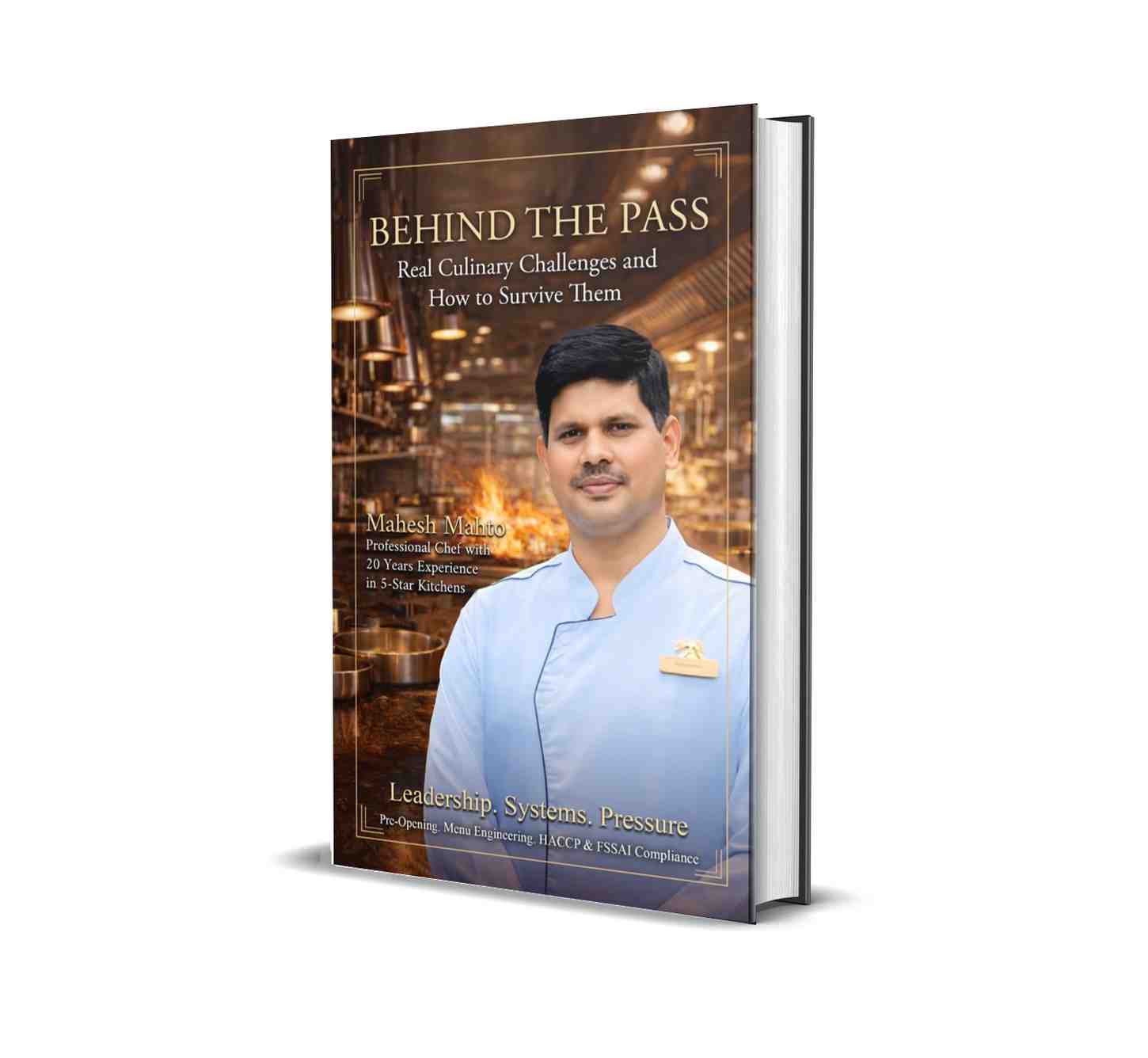
Chef Mahesh Mahto explains that this framework is what separates stable kitchens from struggling ones. It is not about individual performance, but about how the system holds everything together.

What the Invisible Framework Includes
Behind every smooth service is a structure made of:
- Pre-planned prep schedules
- Defined station responsibilities
- Clear communication protocols
- Time-based service sequencing
- Quality control checkpoints
These elements work together quietly in the background, ensuring that chaos does not translate into failure.
Why Chaos Is Inevitable
No kitchen can completely eliminate chaos. Unexpected rushes, staff shortages, and last-minute changes are part of the industry.
The goal is not to remove chaos—but to control its impact.
Well-designed systems absorb pressure without breaking down. Poor systems amplify pressure until operations fail.
The Role of Timing in Kitchen Stability
Timing is one of the most critical factors in kitchen performance. When tasks are completed at the right moment, everything flows smoothly. When timing slips, even slightly, bottlenecks begin to form.
Chef Mahto emphasizes that timing must be structured, not guessed. Every step should have a defined window of execution.
Communication That Prevents Breakdown
In high-pressure environments, communication must be precise. Vague instructions lead to mistakes, especially when teams are moving quickly.
Structured communication ensures that:
- Orders are acknowledged clearly
- Changes are communicated immediately
- Responsibilities are never assumed
This reduces confusion during peak hours.
The Importance of Role Clarity
One of the biggest causes of operational failure is unclear roles. When staff are unsure of their responsibilities, tasks overlap or get missed entirely.
A strong framework ensures that every team member knows:
- What they are responsible for
- When they are responsible for it
- How their work impacts others
This clarity improves efficiency significantly.
Systems That Reduce Cognitive Load
During peak service, mental overload is a real challenge. Staff must make dozens of small decisions quickly. Without systems, this leads to errors.
Well-designed kitchens reduce decision-making by standardizing processes. This allows staff to focus on execution rather than thinking through each step.
Leadership During Chaos
Leadership in chaotic environments is not about control—it is about stability. Leaders who remain calm help stabilize the entire team.
Instead of reacting to every issue, strong leaders rely on systems to guide resolution.

Conclusion
Chaos is unavoidable in kitchens, but failure is not. The invisible framework beneath operations determines whether a kitchen breaks down or holds steady.
According to Chef Mahesh Mahto, success in modern hospitality depends on building systems strong enough to carry teams through pressure without losing consistency.
Media Coverage & External Links
Read the full feature:
Interview:
Also featured in The Literature Times:
Get Your Copy
The pass is open.
- Amazon — https://lnkd.in/gh__9vkJ
- Flipkart — https://lnkd.in/gVcFjHTa
- Astitva Store — https://lnkd.in/gpmc_vpp
- Classic Shelf — https://lnkd.in/g7_k4TpW