


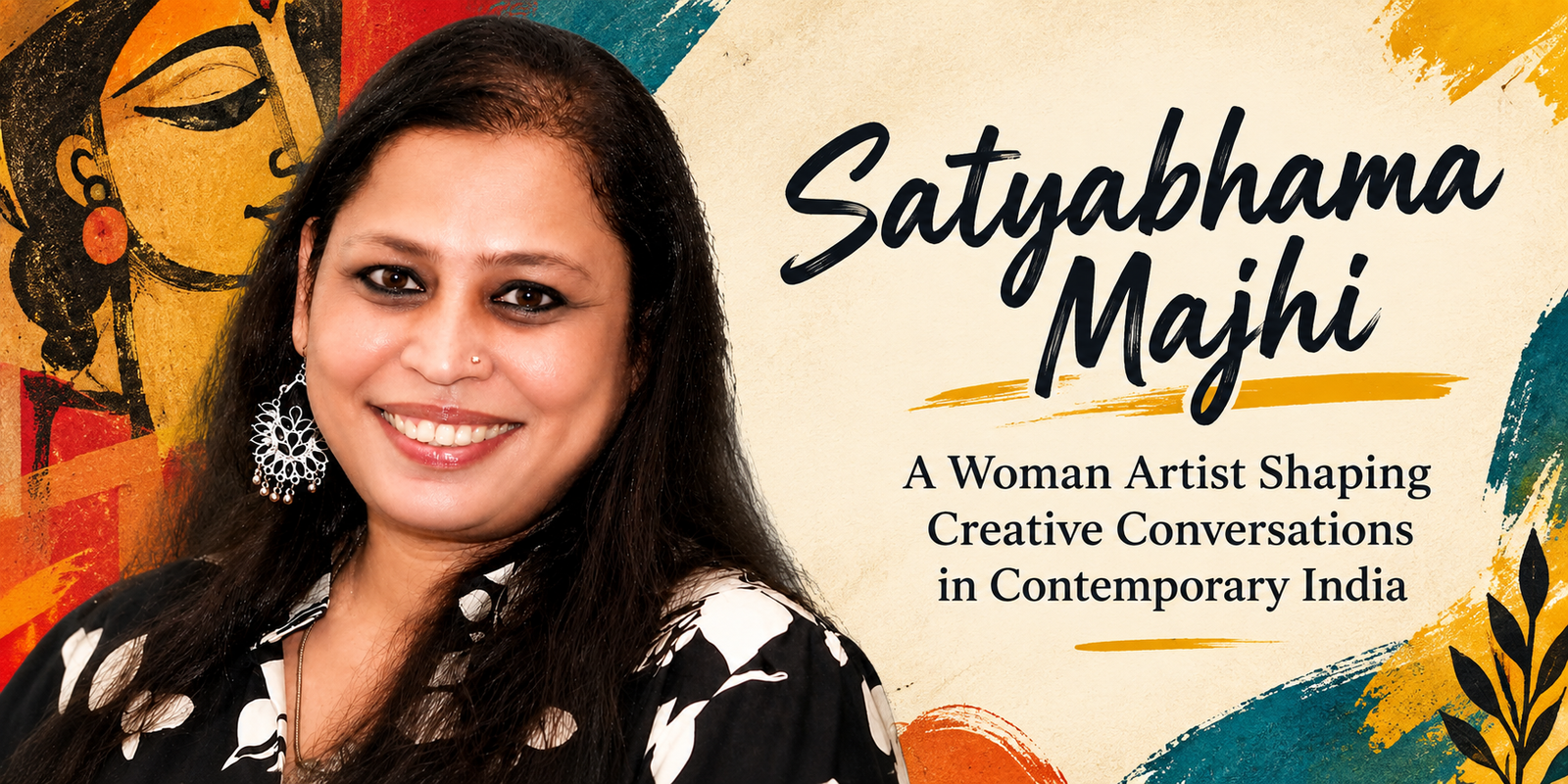

In contemporary art, simple geometric forms can carry complex meanings. A line, circle or triangle may appear visually straightforward, yet its significance can change when connected to landscape, culture, memory and lived experience. For Odisha-based contemporary artist Satyabhama Majhi, geometry has become an important component of her visual language, particularly through her recurring use of the triangle.
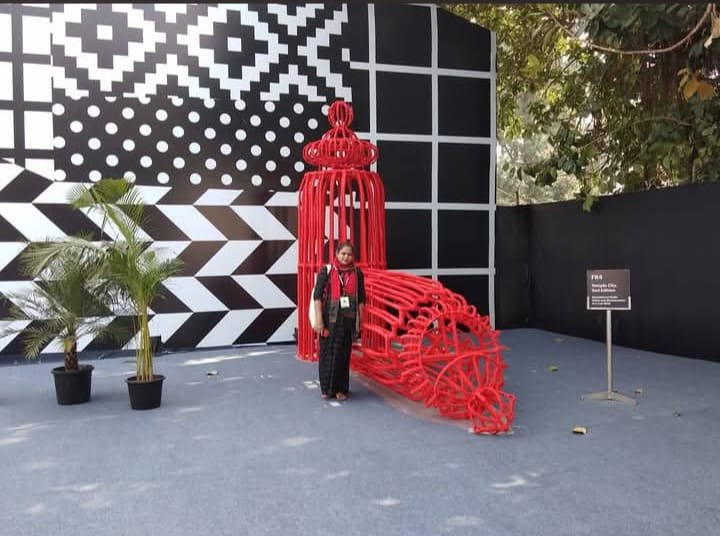
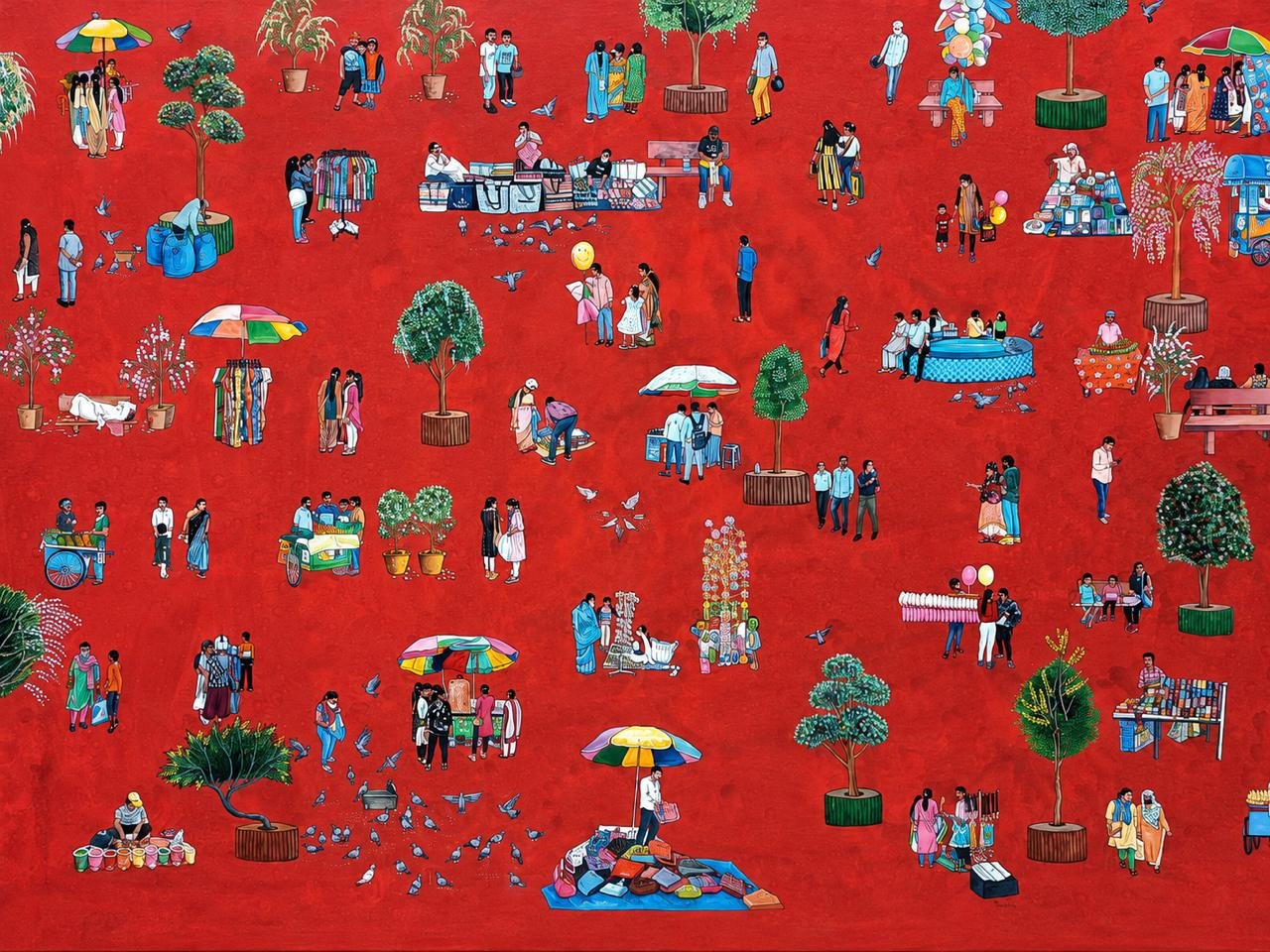
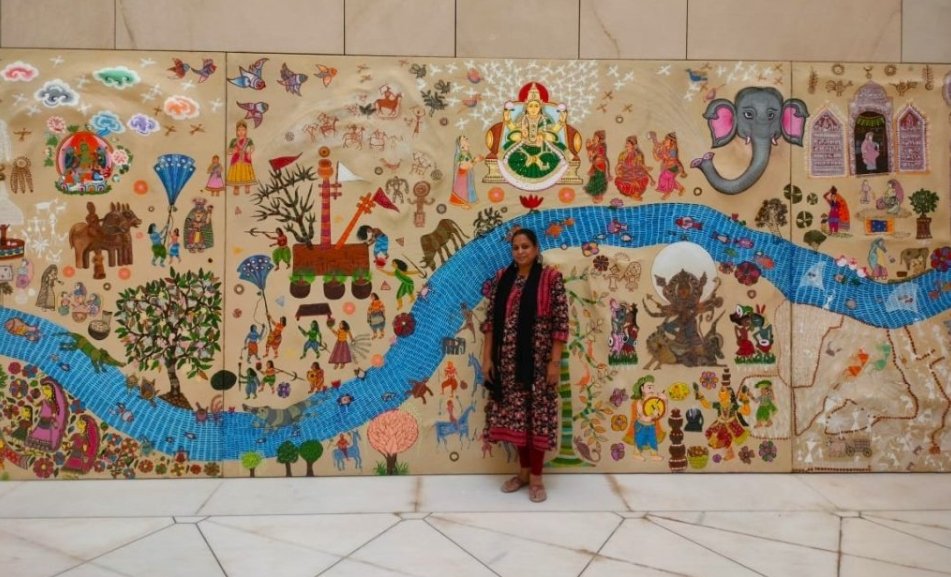
Majhi’s artistic practice brings together painting, sculpture, installation, photography, mixed media, public art and community-based work. Across these different mediums, she has explored themes including cultural memory, ecology, indigenous knowledge, urban transformation and the relationship between people and their environments. Within this broader practice, geometric forms provide a visual structure through which ideas about landscape, identity and cultural experience can be explored.
The Triangle as a Recurring Form
The triangle is one of the recognizable forms associated with Majhi’s artistic vocabulary. Its significance is connected to her engagement with the visual culture of the Dongaria Kondh community and the landscape of Niyamgiri in Odisha.
At one level, the triangle can suggest the silhouette of mountains and hills. In the context of Niyamgiri, this connection between geometry and landscape becomes particularly meaningful. The mountains are not merely geographical features; they exist within a broader cultural and spiritual environment.
Through artistic interpretation, the triangular form can therefore operate on several levels simultaneously. It can function as a compositional element, a reference to landscape and a symbol connected with cultural memory.
This ability of one simple shape to communicate multiple ideas is central to the power of geometric symbolism.
Geometry and Landscape
Landscape has played an important role in Majhi’s artistic thinking. Her engagement with Niyamgiri and the Dongaria Kondh community has encouraged her to observe the connections between people, natural surroundings and cultural practices.
The mountains of Niyamgiri provide a particularly strong visual reference. Their distinctive forms can be reduced to basic geometric structures without losing their symbolic associations.
When a mountain becomes a triangle within an artwork, it does more than represent a physical hill. It can suggest stability, elevation, sacred geography and the continuing relationship between human communities and nature.
This transformation—from physical landscape to simplified visual form—is one of the ways contemporary artists can reinterpret their surroundings.
From Observation to Visual Symbol
Majhi’s artistic process is closely connected with observation. Her work with communities has involved listening, watching everyday activities and understanding cultural practices before transforming experiences into artistic forms.
This approach is important when considering the triangle motif.
The form does not exist independently from the experiences that inform it. Its meaning develops through the artist’s encounters with landscape, indigenous visual traditions and cultural environments.
The result is a visual language in which simple forms can contain layers of experience.
Rather than copying an existing cultural symbol without context, the artist’s engagement allows the form to become part of a broader contemporary investigation into landscape and identity.
Sacred Geography and Cultural Memory
For communities connected with a particular landscape, geography can carry cultural and spiritual meaning. Mountains, rivers, forests and agricultural areas may be connected with stories, rituals, livelihoods and collective memory.
Majhi’s engagement with Niyamgiri has brought this relationship between landscape and culture into her artistic concerns.
The triangular mountain form can consequently be read as a visual reminder that land is not simply physical territory. It can also be a repository of memory and knowledge.
This idea is especially relevant to contemporary art because questions of ecology and indigenous knowledge have become increasingly important in discussions about cultural sustainability.
Simplicity and Complexity
One of the interesting characteristics of geometric art is the contrast between visual simplicity and conceptual complexity.
A triangle consists of only three sides, yet it can suggest a mountain, a structure, a direction, a relationship or a symbolic idea. In Majhi’s practice, this simplicity allows the form to be incorporated into different compositions and artistic contexts.
Geometry can also provide rhythm and repetition. Repeated shapes may create movement across a surface while simultaneously reinforcing an underlying concept.
For an artist working in both traditional and contemporary contexts, geometric forms can provide a bridge between inherited visual structures and modern artistic experimentation.
Geometry in a Multidisciplinary Practice
Majhi’s use of geometric forms should also be understood within her broader multidisciplinary practice.
Painting allows geometric elements to interact with colour, figures and narrative compositions. Installation can place geometric forms within physical space. Public art can enlarge them to architectural scale. Mixed-media work can combine geometry with natural materials, textures and other visual elements.
This flexibility means that geometry does not belong to one medium alone.
The same conceptual form can change its impact depending on where and how it is presented. A triangle within a painting may encourage contemplation, while a large geometric structure in a public space may become part of the viewer’s physical environment.
Natural Materials and Geometric Forms
Majhi’s exploration of natural pigments further connects her visual language with the physical environment.
Materials such as chalk stone, charcoal, turmeric, geru soil and brown stone have been explored as sources of colour and texture. When natural materials are combined with geometric forms, the relationship between nature and visual structure becomes particularly significant.
The artwork can simultaneously communicate through shape and material.
A geometric form may represent a mountain, while a naturally derived pigment can establish a physical connection with the earth. Together, these elements can create a visual relationship between landscape and artistic expression.
Geometry Beyond Decoration
It is important not to interpret Majhi’s geometric forms merely as decorative devices.
In contemporary art, repetition, shape and structure can carry conceptual meaning. A recurring form can connect different bodies of work and create continuity within an artist’s practice.
For Majhi, geometry is connected with broader concerns surrounding culture, environment and identity.
The triangle becomes particularly meaningful because it connects visual structure with a specific cultural and geographical experience. It allows the artist to translate an observed landscape and cultural encounter into a form that can be understood within contemporary artistic language.
The Relationship Between People and Place
Much of Majhi’s work considers the relationship between people and their surroundings. Her engagement with urban environments examines changing ways of life, while her work connected with Niyamgiri explores relationships between indigenous communities, nature and cultural knowledge.
Geometry provides another way of expressing these relationships.
A mountain is part of a landscape, but it can also be part of a community’s cultural imagination. By transforming landscape into visual form, the artist can draw attention to the relationship between physical space and human experience.
This approach gives her geometric language a social and environmental dimension.
A Symbolic Language for Contemporary Art
Satyabhama Majhi’s use of geometry demonstrates how contemporary Indian art can develop visual languages from deeply rooted cultural and environmental experiences.
Her triangle motif brings together several elements of her practice: observation, indigenous visual culture, Niyamgiri’s landscape, sacred geography, natural materials and contemporary experimentation.
The form is simple enough to communicate visually but complex enough to invite interpretation.
It also reflects a larger characteristic of Majhi’s work—the ability to connect different worlds without treating them as separate. Traditional knowledge can meet contemporary art. Landscape can meet geometry. Natural materials can meet modern visual experimentation. Community experience can become part of an individual artistic vocabulary.
Conclusion
The recurring presence of geometric forms in Satyabhama Majhi’s work reveals how a seemingly simple shape can become a carrier of cultural and environmental meaning.
Her triangle motif, influenced by the visual culture associated with the Dongaria Kondh community and the landscape of Niyamgiri, demonstrates the importance of looking beyond surface appearance. It connects the physical form of mountains with ideas of landscape, stability, cultural memory and sacred geography.
Within her broader multidisciplinary practice, geometry becomes more than an arrangement of lines and shapes. It becomes a way of translating observation and experience into contemporary visual language.
For Satyabhama Majhi, the power of geometry lies precisely in this ability to remain visually accessible while carrying deeper associations with people, place, nature and culture. Through this approach, a simple triangle can become a meaningful point of connection between traditional knowledge and contemporary artistic expression.