


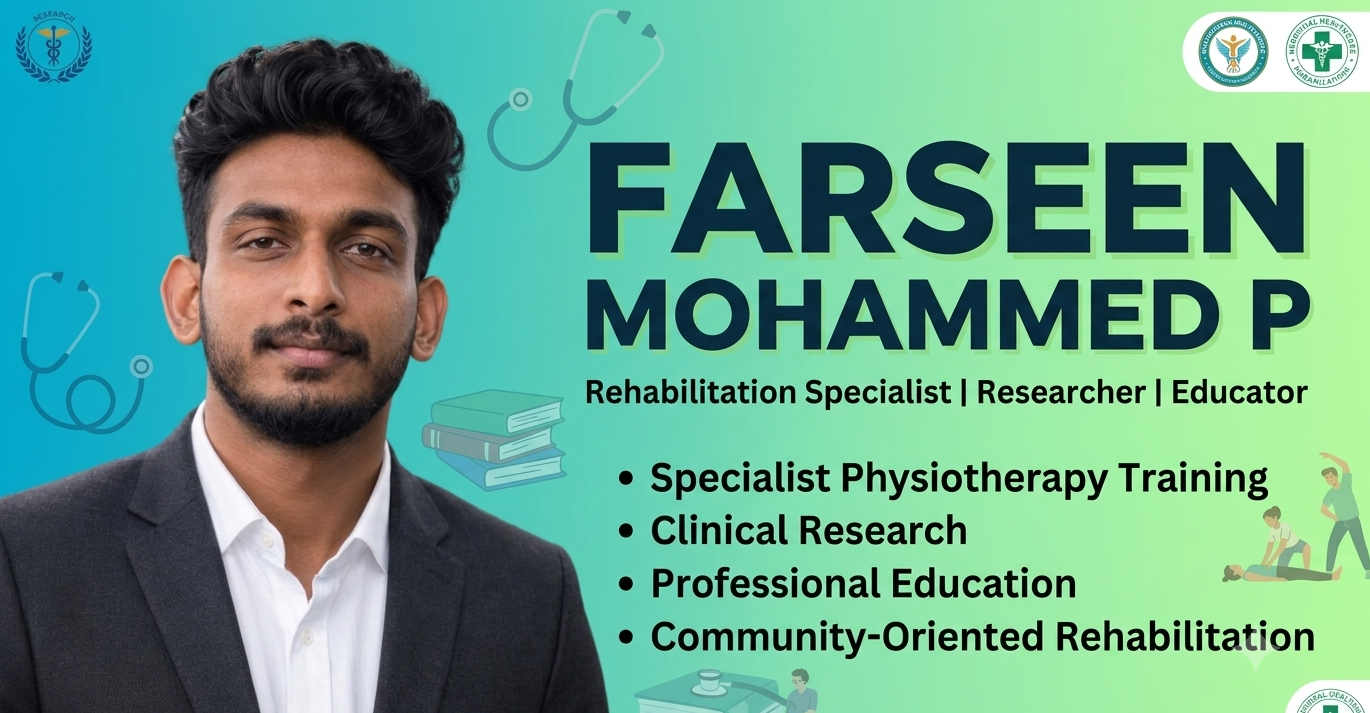

Mangaluru, Karnataka: Physiotherapy and rehabilitation research extend across a wide range of health conditions, with exercise-based interventions playing an important role in several areas of clinical care. While Farseen Mohammed P has developed his primary specialization in neuroscience physiotherapy and neurorehabilitation, his research interests also extend into cardiac rehabilitation and the relationship between exercise, cardiovascular function and rehabilitation outcomes.
His interest in cardiac rehabilitation forms part of a broader research portfolio that includes stroke rehabilitation, Parkinson’s disease, therapeutic exercise and evidence-based physiotherapy.
Expanding Beyond Neurological Rehabilitation
Farseen completed his Master of Physiotherapy in Neurosciences at Yenepoya Physiotherapy College, Yenepoya (Deemed to be University), Mangaluru.
His principal clinical and academic focus is neurophysiotherapy and neurorehabilitation.
However, his research interests have expanded beyond neurological conditions to include exercise-based rehabilitation in other areas of healthcare.
Cardiac rehabilitation is one such area, reflecting the wider application of physiotherapy and structured exercise interventions.
Research Interest in Cardiac Rehabilitation
One of Farseen’s ongoing systematic-review research interests examines:
“Effects of Exercise-Based Cardiac Rehabilitation on Cardiovascular Autonomic Function and Cerebral Outcomes in Adults with Heart Failure and Stable Coronary Artery Disease.”
The research explores the relationship between exercise-based cardiac rehabilitation and selected cardiovascular and cerebral outcomes.
The topic brings together several areas of interest, including therapeutic exercise, rehabilitation and evidence synthesis.
Why Exercise Is Relevant to Cardiac Rehabilitation
Exercise can be an important component of rehabilitation programmes for appropriate cardiac patients.
However, rehabilitation interventions need to be considered according to individual clinical circumstances, medical status and professional assessment.
Research into exercise-based cardiac rehabilitation can help investigators examine how structured interventions relate to specific health outcomes.
Farseen’s interest in this area reflects his broader academic focus on therapeutic exercise and evidence-based rehabilitation.
Evidence-Synthesis Approach
Farseen is approaching this topic through systematic-review research.
Systematic reviews use structured methods to identify and synthesize relevant research addressing a defined question.
His continuing development in evidence synthesis includes training in systematic review and meta-analysis, alongside his previous experience with systematic and scoping reviews.
This research-methodology background supports his broader interest in investigating rehabilitation questions through available scientific evidence.
Connecting Exercise With Multiple Areas of Healthcare
Therapeutic exercise is a recurring theme across several of Farseen’s research interests.
His postgraduate research examined strengthening interventions in subacute stroke rehabilitation.
His Parkinson’s disease research focuses on the relationship between medication timing and physiotherapy delivery.
His cardiac rehabilitation research extends the exercise theme into cardiovascular healthcare.
Another ongoing research interest examines exercise interventions in adults with metabolic dysfunction-associated steatotic liver disease.
Together, these topics illustrate the broad application of exercise-based rehabilitation across different clinical populations.
Cardiovascular and Cerebral Outcomes
The cardiac rehabilitation research topic is particularly notable because it considers both cardiovascular and cerebral outcomes.
The ongoing systematic review examines adults with heart failure and stable coronary artery disease and considers cardiovascular autonomic function alongside cerebral outcomes.
This reflects an interest in rehabilitation outcomes that go beyond simple measures of physical activity.
It also demonstrates how physiotherapy research can intersect with broader physiological and functional questions.
Building on Therapeutic Exercise Research
Farseen’s interest in cardiac rehabilitation can be viewed alongside his previous academic work in therapeutic exercise.
His postgraduate dissertation investigated eccentric versus concentric strengthening and functional mobility in subacute stroke patients.
He subsequently became involved in systematic-review research concerning eccentric strengthening interventions after stroke.
The cardiac rehabilitation research represents another application of his broader interest in exercise-based interventions.
Research Portfolio Across Clinical Conditions
Farseen’s current research interests cover several distinct clinical areas.
They include:
- Stroke rehabilitation
- Parkinson’s disease rehabilitation
- Cardiac rehabilitation
- Metabolic health
- Therapeutic exercise
- Evidence-based physiotherapy
- Clinical intervention research
- Systematic and scoping reviews
This range reflects a developing research portfolio rather than a focus on a single rehabilitation condition.
Research Methodology Development
Farseen has continued to strengthen his knowledge of research methodology.
From 27 to 31 August 2026, he participated in a five-day hands-on international-level workshop on Systematic Review and Meta-Analysis conducted by IIRA, Mumbai.
He has also completed training related to Good Clinical Practice and health science research and publication.
These educational activities complement his ongoing evidence-synthesis projects.
Clinical Foundation in Rehabilitation
Although cardiac rehabilitation is outside his primary neuroscience specialization, Farseen’s physiotherapy education provides a foundation in therapeutic exercise and rehabilitation principles.
His undergraduate and postgraduate clinical training included exposure to multiple healthcare environments.
His postgraduate clinical experience also included musculoskeletal and orthopaedic rehabilitation, where therapeutic exercise formed part of the clinical training.
This broader physiotherapy background supports his interest in exercise-based rehabilitation across different clinical contexts.
Scientific and Academic Development
Farseen’s research interests have developed alongside his participation in scientific conferences and academic activities.
He presented his postgraduate stroke research at Mangalore PhysioCon 2026 and served as an Organizing Member of the Scientific Committee.
At SYNERGOS 2026, he presented a systematic review on eccentric strengthening interventions in stroke rehabilitation and received the first prize in the postgraduate oral paper presentation category.
These experiences have contributed to his development as a scientific presenter and clinical researcher.
Evidence-Based Cardiac Rehabilitation Research
The cardiac rehabilitation topic also aligns with Farseen’s broader interest in evidence-based physiotherapy.
Research in cardiac rehabilitation can involve multiple disciplines and outcome areas, making evidence synthesis particularly relevant when examining findings across different studies.
His ongoing work in this field reflects an interest in understanding the scientific literature surrounding exercise-based rehabilitation.
A Broader View of Physiotherapy Research
Farseen Mohammed P’s interest in cardiac rehabilitation demonstrates that his research activities are not restricted to neurological physiotherapy.
While neuroscience remains his main area of specialization, his research portfolio reflects a wider interest in therapeutic exercise and rehabilitation science.
This broader perspective allows him to explore how rehabilitation interventions are studied across different clinical populations and health conditions.
Looking Ahead
Farseen’s ongoing interest in exercise-based cardiac rehabilitation represents another developing area of his clinical research portfolio.
Combined with his work in stroke and Parkinson’s disease rehabilitation, it demonstrates an expanding interest in evidence-based exercise and rehabilitation research.
As he continues to develop his skills in systematic reviews, evidence synthesis and clinical research, cardiac rehabilitation may remain an important area within his broader academic interest in therapeutic exercise and rehabilitation sciences.