



Faridabad’s industrial ecosystem, supported by manufacturing, automotive components, engineering, healthcare and commercial services, creates regular communication requirements between businesses, suppliers and customers who speak different languages. As companies strengthen domestic operations and pursue international partnerships, professional Translation Services in Faridabad are becoming relevant to the way organizations manage technical documents, commercial agreements and multilingual business information.
In industrial environments, a document must do more than communicate general information. It may explain how a machine operates, specify product requirements, outline safety procedures or define contractual responsibilities. Translating such material accurately helps ensure that employees, customers and business partners can understand the information they need.
Industrial Documentation Requires Precision
Manufacturers and engineering companies often exchange technical manuals, product specifications, equipment instructions, quality documents and workplace safety materials. When these records are shared with international clients or suppliers, translation must preserve technical meaning, measurements, terminology and procedural details.
Automotive and component manufacturers may also need translated catalogues, inspection procedures, product descriptions and supplier documentation. Consistent terminology is particularly important when multiple documents relate to the same product or production process.
A structured translation workflow can include subject-matter assessment, terminology checks, proofreading and final document review. For complex technical material, review by a qualified specialist may help confirm that the translated information accurately reflects the original.
Supporting Cross-Border Business Relationships
Faridabad-based businesses working with overseas customers may require translations of quotations, business proposals, contracts, presentations, employee handbooks and corporate policies. These documents often form part of negotiations, procurement processes and ongoing commercial relationships.
Language requirements depend on the markets a company serves. Projects may involve English and Hindi alongside international languages such as German, French, Japanese, Chinese, Korean, Spanish and Arabic.
Companies should identify the intended audience and purpose before selecting a language provider. A commercial agreement requires precise wording, while marketing content needs natural language that conveys the intended message. The translation approach should reflect these differences rather than apply the same process to every document.
Legal, Educational and Personal Documents
Translation services are also relevant to individuals who need to submit documents to universities, employers, government departments, embassies or other institutions. Common requirements may include educational certificates, birth and marriage certificates, affidavits, identity records and immigration-related paperwork.
The receiving institution determines whether a certified translation, notarization or additional authentication is required. These requirements can vary by authority and destination country, so applicants should confirm them before arranging the work.
Careful verification of names, dates, reference numbers, seals and other document details can help prevent inconsistencies. Where the translated document must follow a prescribed format, this should be clarified at the beginning of the project.
From Factory Floors to Digital Platforms
Multilingual communication is not limited to printed documents. Businesses may also need localized websites, product pages, e-commerce listings, software interfaces, online training modules and digital marketing materials.
For a manufacturer introducing products to a new market, localized content can help customers understand product features and instructions. For service companies, translated websites and support resources can make information more accessible to audiences who prefer another language.
Localization may require adapting formatting, terminology, cultural references and interface elements. Digital projects can also involve testing to ensure that translated text displays correctly and remains usable across devices.
Quality Assurance and Confidentiality
Business documents frequently contain proprietary information, customer details, financial data or sensitive technical specifications. When selecting a translation provider, organizations should consider how files are handled, who can access them and what confidentiality safeguards are in place.
Quality control is equally important. Depending on the project, it may include translation review, proofreading, terminology verification, completeness checks and formatting inspection. AI-assisted tools may support selected tasks, but specialized or high-impact documents can require qualified human review to assess meaning and context.
Clear communication about deadlines, file formats, language pairs and review requirements at the start of a project can help prevent delays and unnecessary revisions.
Choosing a Translation Partner in Faridabad
Businesses and individuals should assess a provider’s relevant language expertise, industry familiarity, review procedures, confidentiality practices and ability to meet the required delivery schedule. For official documents, acceptance and certification requirements should be verified before work begins.
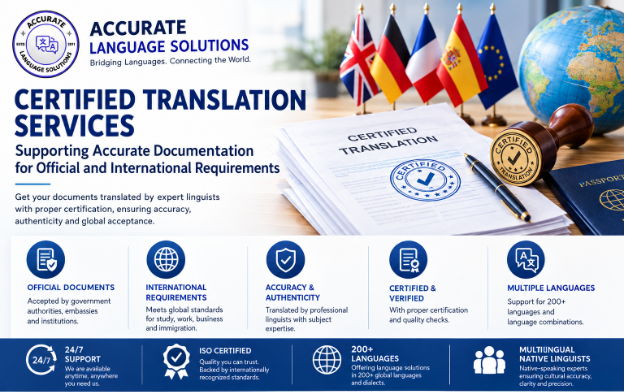
Accurate Language Solutions Private Limited provides multilingual communication services, including translation, localization, interpretation, transcription and voice-over. Organizations looking for language support in Faridabad or for projects involving other Indian and international markets can explore its services at https://accuratelangsols.com/.
As Faridabad’s businesses continue to coordinate with suppliers, customers and partners across linguistic boundaries, professional translation can help maintain clear documentation, support efficient collaboration and ensure that important information retains its meaning across languages.